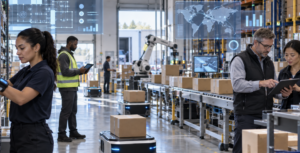
The modern warehouse is undergoing one of the most significant technological transformations in its history. While artificial intelligence, cloud computing, and automation dominate technology headlines, some of their most practical applications are happening behind the scenes in warehouses and distribution centers across the United States. 📦
In 2026, information technology (IT) has become essential to how businesses store inventory, process orders, manage shipments, and deliver products to customers. Operations that once depended heavily on manual paperwork, spreadsheets, and repetitive physical tasks increasingly rely on interconnected software, intelligent equipment, and real-time information.
This transformation reaches far beyond large e-commerce companies. Manufacturers, wholesalers, retailers, and smaller businesses are discovering that modern warehousing technology can improve inventory accuracy, strengthen supply chain visibility, and make fulfillment operations more responsive to changing demand.
The most important development is that warehouses are becoming connected information systems. Every product movement generates valuable data, and that information helps businesses make better decisions about everything from inventory placement to delivery scheduling.
The Digital Warehouse Is Becoming the New Industry Standard
For decades, warehouses primarily served as storage facilities where products remained until they were needed. Today, a competitive distribution center operates as a technology-driven environment where inventory, employees, equipment, and transportation systems work together.
At the center of this transformation is the warehouse management system, commonly called a WMS. This software manages activities such as receiving merchandise, tracking stock locations, coordinating picking operations, and preparing orders for shipment.
As explained in Wikipedia’s overview of warehouse management systems, these platforms organize warehouse operations and support efficient inventory movement throughout a facility.
Modern systems extend those capabilities through mobile devices, barcode scanners, application programming interfaces (APIs), and connections with other business applications.
For example, when a customer purchases a product online, the order can automatically enter the warehouse management system. The software identifies where the product is stored, assigns the picking task, updates inventory records, and sends shipping information to the appropriate carrier.
Instead of relying on multiple disconnected processes, warehouse personnel work within a coordinated digital environment.
The result is greater operational visibility and fewer opportunities for costly communication errors.
Artificial Intelligence Is Changing How Warehouses Make Decisions
Artificial intelligence is moving beyond experimental warehouse projects and becoming part of everyday operational planning.
Traditional warehouse software follows predefined rules. AI-powered systems can analyze historical information, recognize patterns, and recommend adjustments as conditions change.
In September 2026, technology research firm Gartner identified four major artificial intelligence trends reshaping warehouse operations. Its research on AI trends transforming warehousing highlighted advanced optimization, operational generative AI, semiautonomous agents, and physical AI systems.
These technologies can support several important warehouse functions.
Demand forecasting systems analyze purchasing patterns to help determine which products may require additional inventory. Intelligent scheduling tools estimate staffing requirements based on anticipated order volumes. Inventory optimization software can recommend better product locations to reduce unnecessary movement throughout a facility.
Generative AI also has emerging applications in employee training, operational documentation, and exception management.
A warehouse supervisor dealing with an unexpected shipment delay may eventually rely on an AI assistant to summarize affected orders, identify inventory alternatives, and recommend a revised fulfillment schedule.
Human oversight remains important, particularly when decisions affect employee safety, customer commitments, or significant financial investments.
The central advantage of AI is its ability to process operational information quickly enough to help warehouse teams respond before small problems become larger disruptions.
Warehouse Robotics Are Becoming More Intelligent and Practical
Robotics has attracted considerable attention in the logistics industry, but the most important advances involve the intelligence directing automated equipment.
Warehouse robots are increasingly being used to transport inventory, assist with picking operations, move pallets, and organize materials.
A facility with dozens or hundreds of autonomous mobile robots must coordinate their movements carefully. Poor traffic management can create congestion that reduces the benefits of automation.
In March 2026, researchers from the Massachusetts Institute of Technology and Symbotic described a new AI-based approach designed to improve warehouse robot traffic. According to MIT News, the system uses reinforcement learning to determine robot priorities and reduce congestion as operating conditions change.
This research illustrates how software intelligence can improve the performance of existing physical equipment.
Rather than focusing exclusively on purchasing more robots, warehouse operators can potentially gain efficiency by improving how their equipment communicates and coordinates tasks.
Robotics also creates opportunities for employees to move into equipment supervision, system maintenance, quality control, and other technology-supported positions.
Successful implementations require careful planning, employee training, maintenance procedures, and accurate integration with warehouse management software.
For many businesses, the goal is a practical combination of automation and human expertise that improves overall operational performance.
Cloud Computing Is Connecting Warehouses With the Entire Supply Chain
Cloud computing has fundamentally changed how businesses access and share logistics information. ☁️
Previously, warehouse software often operated on local servers with limited integration between facilities, customers, and transportation providers.
Cloud-based systems make it possible for authorized users to access operational information from different locations through connected applications.
A manufacturer can monitor inventory at a distribution center hundreds of miles away. A retailer can examine order fulfillment progress without contacting warehouse personnel. A logistics provider can coordinate operations across multiple facilities using shared reporting tools.
This connectivity becomes especially valuable for businesses working with third-party logistics providers.
Companies evaluating Warehousing and Warehousing and Fulfillment Services increasingly benefit from understanding how inventory visibility, order processing, warehouse technology, and transportation coordination work together.
Cloud connectivity can also help businesses handle seasonal sales fluctuations.
During periods of unusually high order volume, integrated systems make it easier to identify processing bottlenecks, adjust workflows, and distribute orders across available warehouse resources.
However, cloud technology requires dependable internet connectivity, appropriate access controls, reliable integrations, and well-designed recovery procedures.
The value comes from providing accurate information to the people and systems that need it, rather than simply moving warehouse software to a remote server.
Real-Time Inventory Tracking Is Reducing Costly Errors
Inventory accuracy is one of the most important factors influencing warehouse performance.
When inventory records fail to match actual stock levels, businesses can experience canceled orders, unnecessary replenishment, shipping delays, and dissatisfied customers.
Information technology is helping warehouses address these problems through improved data collection.
Barcode scanning remains a widely used inventory tracking method, but radio-frequency identification (RFID) provides additional capabilities.
RFID technology uses electronic tags and readers to identify products and capture information without requiring direct visual scanning of every individual item.
According to GS1 US guidance on RFID warehouse management, properly implemented RFID systems can help businesses identify inventory movements at receiving docks, conveyor systems, and other warehouse locations.
When inventory information is automatically recorded, warehouse systems can maintain more timely records of what enters, moves through, and leaves a facility.
For businesses handling thousands of products, improved inventory visibility can support purchasing decisions, stock replenishment, and order accuracy.
Real-time data also helps warehouse managers identify inventory discrepancies before they interfere with customer orders.
RFID is not the best solution for every product or facility, and implementation requires appropriate tags, readers, systems integration, and cost analysis.
Nevertheless, the broader movement toward automated data capture is making inventory information an increasingly valuable business resource.
Cybersecurity Is Becoming a Critical Warehouse Technology Priority
As warehouse systems become more connected, cybersecurity becomes essential to maintaining reliable operations. 🔐
A modern warehouse may depend on cloud platforms, wireless networks, handheld scanners, automated equipment, transportation management systems, and connections with outside business partners.
Each connected system creates potential security considerations.
Unauthorized access to warehouse software could expose sensitive business information, interfere with inventory records, or disrupt order processing.
Ransomware incidents and other cyberattacks can also affect the availability of systems needed to operate a distribution facility.
The National Institute of Standards and Technology addresses these concerns through its Cybersecurity Framework 2.0, which provides organizations with guidance for understanding, prioritizing, and managing cybersecurity risks.
For warehouse operators, practical cybersecurity measures include controlling employee access, securing mobile devices, updating software, protecting network connections, and maintaining recoverable data backups.
Businesses should also evaluate the security practices of technology vendors and logistics partners that access their systems.
A highly automated warehouse becomes more dependent on the reliability of its digital infrastructure. Cybersecurity planning therefore belongs alongside inventory management, equipment maintenance, and operational safety.
The organizations that treat cybersecurity as part of daily warehouse management will be better positioned to protect both their operations and their customers.
Predictive Analytics Is Helping Prevent Warehouse Disruptions
One of the most promising uses of IT in warehouse operations is predictive analytics.
Rather than waiting for equipment failures, inventory shortages, or shipping bottlenecks to occur, businesses can analyze operational data to identify warning signs.
Warehouse systems collect information about order volume, processing times, equipment activity, inventory turnover, and shipment performance.
When analyzed together, these records can reveal patterns that may be difficult to recognize through manual reporting.
For example, recurring order delays during specific shifts might indicate staffing imbalances, inefficient product placement, or limitations in packing capacity.
Equipment monitoring software can track operating conditions and help maintenance teams identify machinery that requires attention.
Predictive inventory tools can also help businesses prepare for changes in purchasing demand.
The technology is particularly useful when warehouse managers combine automated insights with practical knowledge of their facilities.
Predictions depend on the quality of the underlying information. Incomplete inventory records, inconsistent product identifiers, and outdated operational procedures can weaken analytical results.
Successful predictive analytics therefore begins with accurate data and clearly defined business objectives.
For IT departments supporting logistics operations, the challenge is building systems that transform warehouse activity into useful, reliable information.
E-Commerce Fulfillment Is Driving Faster Technology Adoption
The continuing importance of e-commerce has placed new demands on warehouse operations.
Customers expect accurate order information, dependable shipping estimates, and timely delivery updates. Businesses must coordinate these expectations while managing inventory costs, carrier relationships, and fluctuating order volumes.
Technology plays an important role in meeting these requirements.
An integrated fulfillment system can connect an online storefront with inventory records, warehouse operations, shipping applications, and customer notifications.
When an order is received, the system can verify stock availability, create a picking assignment, generate shipping documentation, and update order status.
These connections reduce the need for employees to repeatedly enter the same information into different applications.
Technology also helps businesses manage fulfillment operations across multiple sales channels.
A company selling products through its own website, online marketplaces, and wholesale accounts benefits from maintaining consistent inventory information across those platforms.
Without reliable synchronization, the business risks selling merchandise that is no longer available.
Returns management is another area where improved software can make a difference.
Digital returns workflows can help warehouse teams inspect returned merchandise, record product conditions, update inventory, and determine whether items can be resold.
As online commerce becomes more operationally complex, effective fulfillment increasingly depends on the quality of the technology supporting it.
Connected Supply Chains Are Making Warehousing More Strategic
Warehousing technology is influencing decisions far beyond the distribution center.
When inventory, transportation, purchasing, and customer information are connected, businesses gain a clearer understanding of how products move through the supply chain.
This visibility can support better coordination between suppliers, warehouse operators, carriers, and retail partners.
In June 2026, Gartner identified several technologies shaping the future of supply chain management, including physical AI, autonomous systems, and connected intelligent platforms. Its 2026 supply chain technology trends report emphasized the importance of integrating technology with business operations.
These developments demonstrate that warehousing is becoming an increasingly important part of broader digital transformation strategies.
For example, a business experiencing unusually strong demand in one region may use integrated data to evaluate whether inventory should be transferred from another distribution center.
A manufacturer facing supplier delays can review available warehouse stock before adjusting production schedules.
Transportation teams can use shipment information to coordinate carrier pickups and reduce avoidable loading delays.
These improvements depend on accurate information exchange between different systems and organizations.
Technology alone cannot eliminate supply chain disruptions, but better connectivity can help businesses recognize problems earlier and respond with more informed decisions.
The Future of Warehouse Technology Will Depend on People and Systems Working Together
Despite rapid advances in artificial intelligence and robotics, people remain central to successful warehouse operations.
Technology implementation requires knowledgeable employees who understand inventory requirements, customer expectations, equipment limitations, and operational priorities.
Warehouse managers must determine which processes benefit most from automation and which activities require human judgment.
IT professionals play an increasingly important role in software integration, cybersecurity, system reliability, analytics, and technical support.
Warehouse employees also need training that reflects changing responsibilities.
A worker who previously depended on paper picking lists may now use a mobile device that provides real-time instructions. A maintenance technician may work with automated equipment and connected monitoring systems. A supervisor may use digital dashboards to identify operational priorities throughout the day.
These changes make communication and workforce development essential parts of technology adoption.
Businesses that invest in reliable systems while helping employees develop technical skills are more likely to achieve lasting operational improvements.
Warehouse modernization works best when technology solves specific operational problems, supports measurable performance goals, and makes employees more effective.
Conclusion: Information Technology Is Redefining Modern Warehousing
The warehouse of 2026 is becoming a connected, data-driven operation where software and physical processes work together.
Artificial intelligence is improving planning and decision-making. Robotics is helping coordinate repetitive material-handling activities. Cloud computing is connecting warehouses with customers and supply chain partners. RFID and digital inventory systems are providing better information about products as they move through distribution facilities.
At the same time, cybersecurity, predictive analytics, and systems integration are becoming increasingly important to dependable fulfillment operations.
The transformation may be less visible than advances in consumer technology, but its effects reach businesses and customers every day.
Faster information sharing, improved inventory accuracy, more responsive order processing, and better coordination between logistics partners all contribute to a more capable supply chain.
For businesses planning their next stage of growth, warehouse technology deserves attention as both an operational investment and a long-term competitive consideration.
The future of warehousing will be shaped by organizations that successfully connect intelligent technology with practical logistics expertise. In 2026, that future is already taking shape inside distribution centers, fulfillment facilities, and supply chains throughout the country. 🚀