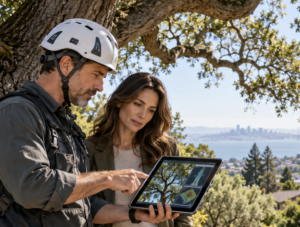
🌳 California’s technology revolution is reaching beyond Silicon Valley’s software companies and into an industry that most property owners rarely associate with digital innovation: professional tree management. Across the San Francisco Bay Area, advanced mapping systems, drone technology, digital tree inventories, and sophisticated diagnostic equipment are changing how arborists evaluate trees, identify potential hazards, and help protect valuable real estate.
For homeowners, commercial property investors, developers, and property managers, these advances have practical financial implications. A mature tree can contribute to a property’s appearance, provide welcome shade, and enhance its surrounding landscape. However, a tree affected by structural weakness, root damage, disease, or unstable soil conditions can become an expensive concern, particularly when construction, insurance inspections, or property transactions are involved.
The growing intersection between information technology and arboriculture is particularly relevant in Northern California, where established neighborhoods, expensive real estate, environmental regulations, and seasonal weather risks create complicated decisions about tree preservation.
As California IT continues to influence traditional industries, consulting arborists are finding new ways to combine scientific expertise with digital information. Their work demonstrates how technology can help property owners make better decisions before a small tree problem becomes a major financial liability.
🌐 California IT Innovation Is Transforming Traditional Tree Management
Technology has changed how California businesses manage everything from transportation networks to construction projects. Tree management is increasingly benefiting from many of those same developments.
Traditionally, an arborist evaluating a property relied heavily on visual inspections, physical measurements, field notes, and professional experience. Those methods remain essential, but digital tools can make the resulting information easier to organize, interpret, compare, and communicate.
Modern tree management may incorporate geographic information systems, GPS positioning, high-resolution photography, electronic inspection records, and specialized software that documents tree conditions over time.
For example, a property manager responsible for hundreds of trees across multiple commercial properties can use a digital inventory to identify which trees need routine maintenance, which require further assessment, and which should receive priority attention.
This kind of organized information is especially valuable when different contractors, property managers, and ownership teams need access to consistent records.
The broader concept is supported by the development of urban forestry, a field combining tree management, environmental science, public planning, and community development.
California’s technology sector provides a natural environment for expanding these practices. The resulting improvements are not simply about replacing paper records with digital files. They can create a clearer picture of landscape conditions and help people make decisions based on documented evidence rather than assumptions.
🛰️ Drone Technology and Aerial Mapping Reveal Problems That Ground Inspections May Miss
Some of the most interesting developments in modern arboriculture involve looking at trees from above.
Drones equipped with high-resolution cameras can capture detailed images of large trees, wooded properties, and areas that are difficult to access safely from the ground. Depending on the equipment and conditions, these images may help professionals observe canopy structure, broken limbs, dead branches, and areas of visible decline.
For large commercial properties, residential developments, and hillside estates, aerial imagery can provide useful context before a more detailed inspection begins.
A drone survey might reveal sections of a canopy that deserve closer attention, but photographs alone cannot establish whether a tree is structurally safe. An arborist still needs to interpret the evidence, evaluate site conditions, and determine whether additional investigation is necessary.
Another important development is LiDAR, or Light Detection and Ranging. This technology uses laser measurements to produce detailed representations of terrain and physical features.
The U.S. Geological Survey explains how LiDAR captures elevation information and produces detailed spatial datasets that can support environmental analysis.
In California, LiDAR-derived information can help professionals study canopy height, terrain characteristics, and vegetation patterns. A California statewide dataset published through NASA’s Oak Ridge National Laboratory data archive in October 2026 demonstrates the scale of this technology’s potential for land-use planning and ecosystem analysis.
daac.ornl.gov+1
While specialized equipment is not necessary for every residential inspection, these developments are expanding the information available for complicated projects.
For Bay Area property owners managing steep terrain, large tree populations, or significant construction activity, the ability to combine aerial information with an experienced arborist’s observations can be particularly useful.
🏡 Why Technology-Based Tree Assessments Matter for Bay Area Real Estate
Real estate investments in the Bay Area often involve substantial financial commitments. Buyers may carefully review foundations, roofing systems, drainage, and property boundaries while overlooking the condition of mature trees.
That oversight can become expensive when an apparently healthy tree requires major corrective work, interferes with planned construction, or presents a potential hazard near a building.
A professional tree assessment can provide information that complements the broader property inspection process.
Consulting arborists evaluate factors such as tree species, visible defects, structural condition, root environments, previous maintenance, and surrounding site characteristics. When appropriate, they may recommend additional testing or monitoring.
Digital documentation adds another layer of usefulness by providing photographs, location information, assessment records, and written recommendations that property owners can retain for future reference.
A buyer considering a house with several large trees may benefit from understanding whether those trees require routine care or further investigation before closing. Similarly, a commercial investor purchasing a property with extensive landscaping can use a tree inventory to anticipate maintenance priorities.
The USDA Forest Service’s Urban Forest Inventory and Analysis Program recognizes the environmental, social, and economic benefits of urban trees, including their relationship to real estate value.
US Forest Service Research and Development
However, tree value is not determined by appearance alone. Location, condition, maintenance needs, and potential conflicts with structures can all influence how trees affect an individual property.
The real advantage of advanced assessment methods is that property owners can better understand these factors before making expensive decisions.
🔍 Advanced Tree Diagnostics Help Identify Hidden Structural Problems
One of the greatest challenges in tree management is that serious structural problems are not always visible from the outside.
A tree may have a full canopy and appear healthy while containing internal decay, weakened wood, or root-related defects. Conversely, an older tree with an unusual shape may remain structurally suitable for its location.
This is where specialized diagnostic technology can provide useful additional information.
Depending on the situation, arborists may use sonic tomography to investigate internal wood conditions, resistance drilling to examine localized areas, or other testing methods to better understand suspected defects.
Sonic tomography measures how sound travels through wood. Variations in those measurements can help trained professionals identify areas that may contain decay or structural abnormalities. The resulting information can be presented visually, making complicated findings easier for property owners to understand.
These tools are not substitutes for professional judgment, and no diagnostic method can guarantee that a tree will never fail. Environmental conditions, structural defects, and changing weather can influence tree stability.
The International Society of Arboriculture’s Tree Risk Assessment Qualification emphasizes systematic risk assessment and informed decision-making by qualified professionals.
WCISA+1
For real estate investors, advanced diagnostic methods may be especially valuable when evaluating a significant tree near a residence, parking structure, commercial building, or frequently used outdoor space.
Rather than removing a tree solely because of uncertainty, a consulting arborist can evaluate the available evidence and recommend an appropriate course of action. That recommendation might involve monitoring, pruning, additional investigation, site improvements, or removal when justified by the findings.
📊 Digital Tree Inventories Are Becoming Valuable Property Management Tools
A single mature tree may be relatively easy to monitor. A commercial property containing dozens or hundreds of trees presents an entirely different management challenge.
Without organized records, property managers may struggle to track previous inspections, maintenance recommendations, and changing tree conditions.
Digital inventory systems help address this problem by creating an accessible record of individual trees and their associated information.
A typical inventory may include species identification, approximate location, trunk measurements, condition observations, maintenance history, photographs, and recommended follow-up activities.
Geographic information systems allow this information to be displayed on interactive maps, giving property managers a useful overview of their landscape assets.
For example, an apartment community can map its trees and identify areas requiring special attention before scheduled construction. A commercial property owner can review maintenance priorities across multiple locations without relying entirely on scattered paper records.
Digital systems also make it easier to compare inspection findings over time. When a tree develops visible changes or requires additional attention, its previous records can help provide context.
The USDA’s i-Tree tools demonstrate how software can help quantify tree-related environmental benefits, including carbon storage, energy savings, and stormwater interception.
USDA Climate Hubs
For California property owners, this combination of inventory management and environmental analysis creates opportunities for more informed landscape planning.
An organized tree management program can also help owners prepare budgets, prioritize work, and maintain records supporting long-term property stewardship.
🏗️ Smart Construction Planning Helps Protect Valuable Trees During Development
Construction projects create some of the most complicated tree management situations in the Bay Area.
New foundations, underground utilities, driveways, grading, and drainage improvements can disturb root systems even when the tree itself is never directly touched.
Damage may not become immediately apparent. A tree affected by extensive root disturbance can develop stress or decline after construction has already been completed.
Consulting arborists can help identify potential conflicts before excavation or grading begins.
Digital site plans, mapping software, and detailed tree surveys make it easier for project teams to understand the relationship between proposed improvements and existing vegetation.
When a mature tree occupies an important location on a development site, an arborist may evaluate its condition, identify areas needing protection, and recommend adjustments to construction activities.
These recommendations can inform decisions about equipment access, excavation methods, protective fencing, and the placement of structures.
Local tree protection requirements are another important consideration. Bay Area municipalities have different rules governing protected trees, removals, construction impacts, and permit requirements.
Accurate site documentation can help developers and property owners understand the trees involved and coordinate with the appropriate local authorities.
The value of this planning extends beyond regulatory considerations. Preserving a healthy mature tree can retain established landscaping that might otherwise take decades to replace.
For developers seeking to balance project feasibility with environmental responsibility, consulting arborists provide technical information that can support more practical decisions.
🌳 Technology Is Helping California Measure the Environmental Value of Trees
Trees are often evaluated as landscaping features, but their influence reaches well beyond appearance.
Urban trees provide shade, absorb carbon dioxide, support wildlife, intercept rainfall, and contribute to neighborhood comfort.
These benefits are increasingly measurable through digital modeling and environmental data analysis.
The U.S. Environmental Protection Agency explains that trees and vegetation can reduce urban temperatures through shade and evapotranspiration while contributing to energy conservation, stormwater management, and air quality improvements.
US EPA
This information has implications for Bay Area real estate, particularly in neighborhoods containing extensive pavement, buildings, and limited natural shade.
A strategically located tree may help reduce heat exposure around a structure. Larger canopy coverage can also improve outdoor comfort, making landscaped spaces more usable during warmer weather.
Technology makes it possible to examine some of these benefits in greater detail, but environmental models depend on the accuracy of the underlying data and assumptions.
A tree’s species, maturity, condition, and location influence the benefits it provides.
By integrating field observations with digital environmental tools, consulting arborists can contribute to a more complete understanding of the role trees play in property management.
For investors and property owners considering long-term improvements, this information can help distinguish between trees that provide substantial benefits and those requiring additional management attention.
💼 Consulting Arborists Are Becoming Important Advisors in Real Estate Investment Decisions
The relationship between tree management and real estate investment is becoming more relevant as property owners seek better information about maintenance obligations and environmental risks.
Trees can affect construction plans, insurance discussions, landscaping budgets, and the practical use of outdoor spaces.
A consulting arborist brings specialized knowledge to situations where these considerations may influence financial decisions.
For homeowners preparing to sell, a professional assessment may help document the condition of important trees and identify maintenance concerns before potential buyers raise them.
For purchasers, an arborist’s report may provide information about trees near foundations, retaining walls, parking areas, and neighboring structures.
Commercial property owners may benefit from recurring assessments that establish maintenance priorities and help document changes over time.
When significant property decisions are involved, working with an experienced Consulting Arborist Bay Area CA can provide specialized tree evaluation and guidance suited to local conditions.
The practical benefit is not that an assessment eliminates every future problem. It is that owners can make decisions with a clearer understanding of known conditions, potential concerns, and available management options.
Technology strengthens this process by improving recordkeeping, supporting visual documentation, and making technical information more accessible to other professionals involved in a transaction or development project.
🤖 Artificial Intelligence Could Bring Another Layer of Innovation to California Arboriculture
Artificial intelligence is beginning to influence environmental monitoring, image analysis, and geographic data processing.
For arboriculture, AI-based systems offer possibilities for identifying patterns in large collections of tree images, organizing inspection information, and highlighting changes in vegetation over time.
For example, image-analysis software may help identify differences in canopy coverage across repeated aerial surveys. Geographic models may also help researchers examine relationships between tree distribution, terrain, and environmental conditions.
These applications could become especially useful for municipalities and property organizations managing large tree populations.
However, AI-generated observations require careful interpretation. Images alone cannot reliably establish every cause of tree decline, and predictive systems may produce misleading results when training data or site information is incomplete.
A knowledgeable arborist remains essential for determining whether a software-generated finding represents a meaningful concern.
One example of the broader technological progress supporting this field is the NASA-hosted California LiDAR-derived topography and ecosystem structure dataset, published in October 2026. It provides terrain and vegetation information suitable for applications such as ecosystem monitoring, urban planning, and environmental change analysis.
daac.ornl.gov
Although statewide datasets do not replace individual property inspections, they illustrate how geospatial computing is improving the information available for environmental decision-making.
California’s established technology ecosystem creates opportunities for software developers, researchers, planners, and arboriculture professionals to collaborate on more capable tools.
The challenge will be applying these innovations responsibly without overlooking the importance of field experience and biological expertise.
🌦️ Climate Resilience and Technology Are Changing Long-Term Tree Planning
California’s changing environmental conditions are creating additional reasons to monitor trees carefully.
Extended dry periods, extreme heat, winter storms, and changing site conditions can influence tree health and performance.
In the Bay Area, local conditions vary considerably between coastal communities, inland valleys, hillside neighborhoods, and heavily developed urban areas.
A tree growing successfully in one location may experience different environmental stresses just a few miles away.
Digital inspection records and environmental monitoring can help arborists identify patterns that deserve investigation.
Repeated observations may reveal changes in canopy density, visible decline, or site conditions that could influence future maintenance recommendations.
For property managers responsible for large landscapes, this information can support better scheduling and more consistent management decisions.
The EPA’s research on urban street trees and green infrastructure highlights the importance of trees in managing stormwater, moderating temperatures, and supporting more sustainable urban environments.
US EPA
Preserving healthy trees while identifying legitimate hazards is an important part of climate-conscious property management.
The objective should not be to remove every tree presenting some degree of uncertainty. Instead, property owners can use professional assessments and available technology to select reasonable management measures based on actual conditions.
🚀 The Future of California IT and Professional Tree Consulting
The connection between California IT and consulting arboriculture is likely to become more important as digital tools become easier to access and integrate.
Cloud-based inventories, geospatial analysis, remote sensing, and digital reporting can improve the way tree information is collected and shared.
Real estate professionals may increasingly encounter arborist reports containing detailed photographs, location maps, and electronic documentation alongside traditional findings.
Developers may use integrated site plans to identify tree conflicts earlier in the design process. Property managers may rely on searchable maintenance records rather than waiting for visible problems to develop.
Municipal agencies can also benefit from more complete information about urban tree populations, particularly when planning infrastructure improvements and environmental initiatives.
Yet the most valuable technological developments will be those that help professionals make better decisions, rather than simply generate more data.
A detailed digital map has limited usefulness without accurate tree information. An advanced diagnostic image must be interpreted in the context of the tree’s biology, structure, and surrounding environment.
That is why professional expertise remains central to the future of technology-supported arboriculture.
The successful integration of scientific judgment and digital analysis can help California property owners protect both their landscapes and the financial investments associated with them.
✅ Conclusion: Smarter Tree Management Is Becoming Part of Smarter Real Estate Investment
California’s technology industry is influencing far more than computers, software, and artificial intelligence. It is helping reshape how professionals understand, manage, and preserve the natural features surrounding homes, businesses, and major real estate developments.
For Bay Area property owners, the growing use of digital mapping, aerial imagery, advanced diagnostics, and electronic tree inventories offers a more informed approach to managing valuable landscapes.
These tools can help identify potential concerns, document existing conditions, guide construction planning, and support long-term maintenance decisions.
The financial implications are significant. A poorly understood tree condition can complicate a property transaction or development project, while thoughtful preservation can protect established landscaping and its environmental benefits.
As technology continues to develop, consulting arborists will remain important partners in translating complex environmental information into practical recommendations.
The future of Bay Area tree management is not simply about adopting the newest technology. It is about combining modern information systems with experienced professional judgment to protect trees, support safer properties, and preserve the long-term value of California real estate.